


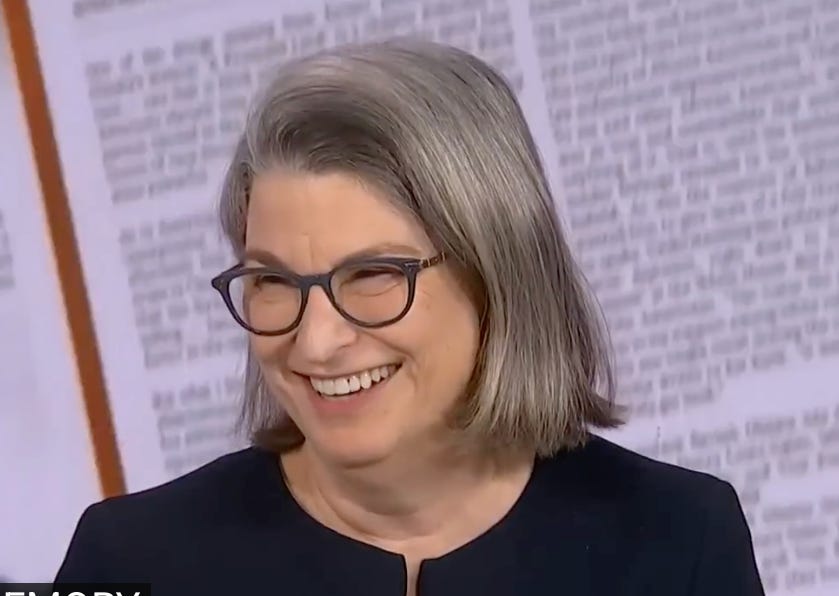
Sally Susman is one of the coolest people I know. Despite being unbearably successful, she’s unaffected, generous, and funny. I can’t remember a conversation with her that didn’t leave me in stitches.
She’s a big deal in corporate America. You might not know her name, but you’ve probably felt her impact.
As executive vice president and chief corporate affairs officer at the pharmaceutical giant Pfizer during the pandemic, Susman spearheaded the company’s efforts to gain the public’s trust in the COVID vaccine. She championed transparency, posting details of clinical trials directly on Pfizer’s website. It was a radical strategy that generated Pfizer – and Big Pharma – enormous good will at a critical time.
Now officially “retired,” Susman is hardly languishing in her pajamas. She serves on numerous boards, including The Pfizer Foundation, UL Solutions, FGS Global, Flutter Entertainment, The New York Public Library, and The Church, an arts organization in Sag Harbor. The author of Wall Street Journal bestseller Breaking Through: Communicating to Open Minds, Move Hearts, and Change the World, she’s now working on a new book.
I met Sally over 20 years ago, when our kids attended the same school in Greenwich Village. But it was only recently that I plumbed the secret of her success. So here’s the nitty gritty: how she bluffed her way into her first big job, her restlessness, being a lesbian in corporate America, and her “traditional” marriage.
Below is an edited version of our conversation.
You’ve had a huge career. Were you one of those people who plotted their path from the age of eight? Absolutely not! I was an undirected kid. I was not a good student. I had no five year plan or even a five minute plan. I didn’t hit my stride until I got into the work world. The young Sally Susman wanted to do good in the world. I thought I wanted to be a Pulitzer prize winning journalist or mayor of my hometown. I had no ambitions tethered to reality.
What snapped you out of it? Work. I loved to work. It’s not just the compensation but the opportunity to grow, to be productive, to be promoted. Work represented a pathway for me that school never did.
That’s definitely not a Gen-Z attitude. So what was your first job? Working for Sen. Thomas Eagleton (D-Mo.) in the mail room. You’ll remember he ran for vice presidential on George McGovern’s ticket in 1972. [Eagleton dropped out when it was disclosed that he had suffered from depression] My job was to read the mail and get it to the right staff person. I worked there for two years until he retired in ‘86.
I can easily picture the young Sally hobnobbing in Washington, eventually becoming the press secretary for some Democrat bigwig. But you traded a political career for the corporate sector. Why? I thought government moved too slowly, and I found it too bureaucratic. My biggest achievement was changing the word “or” to “and” in a piece of legislation.
In Washington, I met a senior executive from American Express, and I pitched myself to work for him. He was very kind, but he basically told me I was a nice girl with a good job, and that I should stay on Capitol Hill. I told him I appreciated his input but that I was definitely leaving the Hill and that if they weren’t interested, I had another appointment with their competitor.
And the truth was …? I didn’t have another appointment. But he perked up! He got me a series of interviews and I ended up as a manager at the public relations department of American Express.
You bullshitted your way to Amex! I love that. More women should be as nervy. What else did you do? l always pushed myself to do the next thing. I worked for American Express in New York for three years, then went back to government [as a deputy assistant secretary in the Commerce Department] when President Clinton got elected. I thought this time Washington would be different. But it was just as bureaucratic. Then American Express called me back to head corporate affairs in Europe.
The point is I was willing to make a change. If I had stayed on the Hill, I wouldn’t have gotten the appointment in the Clinton administration, and if I stayed at American Express, I wouldn’t have gotten the big promotion to its European office.
Being the head of corporate affairs in Europe for Amex sounds pretty sexy to me. But that wasn’t enough for you? It was a great job but I wanted to be boss of my department, and there were two people above me. So I went to Estee Lauder in 2000. I knew nothing about the beauty business or consumer products. I didn’t even wear makeup. It was a smaller department but I was the leader, and I loved it. Then in 2007, I got a call to go into pharmaceuticals, and it was Pfizer.
As one who’s worn makeup since seventh grade, I couldn’t understand why anyone would leave a job with free lipstick. So what attracted you to the world of Big Pharma?
